Buying off-plan property in Dubai from abroad: a step-by-step guide
You can buy an off-plan home in Dubai without living there or holding a UAE visa. What you can do remotely, the power of attorney rules, paying from overseas and non-resident mortgages.
Written by our team
9 min read
You do not need to live in the UAE, hold a UAE visa or have an Emirates ID to buy an off-plan home in Dubai. Most of the purchase can happen from where you live: you sign the papers online, the developer registers the sale with the Dubai Land Department (DLD), and you pay by bank transfer. This guide covers what you can do remotely, what needs paperwork from your home country, how to pay from overseas, and where a mortgage fits in. Rules and fees are as the official pages show them on 5 November 2026.
This is general information, not financial or legal advice.
Can foreigners buy off-plan in Dubai?
Yes, in the areas set aside for it. Regulation No. 3 of 2006 lets non-UAE nationals own property freehold "without time restriction" in designated areas, or hold a lease or usufruct right of up to 99 years (Dubai Legislation Portal, issued 7 June 2006). The first list had 23 areas, and later decisions added more. Most of the communities where new projects launch, such as Jumeirah Village Circle, Business Bay, Dubai Hills Estate and Dubai South, are freehold. Your sale agreement and the DLD registration say what kind of title you get. If a listing says leasehold, ask what that means before you pay anything.
The DLD page for registering an off-plan sale asks individuals for a UAE ID, or a valid passport if they are not resident (DLD, initial sale registration, updated 3 November 2026). Your passport is enough.
New to off-plan? Start with how buying off-plan works.
What you can do from abroad
| Step | From abroad? | What happens |
|---|---|---|
| Reserve the unit | Yes | You sign a reservation form by email or e-signature and send the booking amount by transfer. |
| Sign the sale agreement (SPA) | Usually | Many developers use e-signature. Some still courier a paper copy for you to sign. |
| Oqood registration | Yes | The developer registers the sale with the DLD. You do not need to attend. |
| Instalments | Yes | Bank transfers to the project's escrow account. |
| Mortgage | Partly | Some banks want you to sign in person or through a power of attorney. |
| Handover and snagging | Through someone | A snagging company, a friend or an agent with your power of attorney. |
| Title deed | Yes | Issued after you have paid in full and taken handover. |
Booking and the sale agreement
You reserve a unit and pay the booking amount. On the 991 projects on our site, the median booking amount is 10% of the price: 487 ask 10% or less and 401 ask 20% or more (our analysis of the payment plans listed on our site, November 2026).
You also pay the DLD registration fee at the start. The DLD page lists it as 2% from the seller and 2% from the buyer. In practice most developers pass the full 4% to the buyer unless they run an offer, and every project on our site lists a 4% DLD fee. See the costs on top of the price for the rest.
Ask for the draft SPA before you pay the booking amount. Read the handover date, any grace period, the payment schedule and what happens if you miss a payment. Get answers in writing.
Oqood: the DLD registration
The developer registers your purchase in the DLD's interim register, called Oqood. The DLD says the developer applies through its Oqood portal, and the contract must be registered within 90 days of signing (DLD). You then get an Oqood certificate in your name. Keep it: it is your proof that the sale is on the official record.
The DLD's Dubai REST app shows properties registered to you (DLD). It uses UAE PASS to sign in. Third-party guides say non-residents can create a UAE PASS account with a passport, but we could not confirm this on an official page, so check before you rely on it.
Power of attorney: when you need one
You do not need a power of attorney (POA) to book, sign or pay. You need one if you want someone in Dubai to act for you: at handover, to collect the title deed, to sign a mortgage, to set up utilities or to sell later.
Under DLD Circular No. 29/R/2025 of 16 July 2025, a POA signed outside the UAE is accepted only if it (BSA via Legal 500, 19 August 2025):
- was issued no more than 2 years before you use it,
- was notarised in the country where you signed it,
- was legalised by the UAE embassy or consulate there,
- was then attested by the UAE Ministry of Foreign Affairs,
- is the physical original (scans are not accepted), and
- has a full legal Arabic translation from a UAE-licensed translator.
The Ministry's FAQ lists attestation at AED 150 for an individual's document and AED 2,000 for a commercial document (MOFA). Ask which applies to your POA. Translation and courier costs come on top and vary.
Make the POA specific: name the property and the acts the person can do. If you visit Dubai at any point, signing a POA in front of a notary there is usually quicker than the embassy route. Law firms report that Dubai Courts' notaries can also do some POAs by video call, but eligibility changes, so ask the notary first.
Paying from overseas
Pay only into the escrow account. Under Law No. 8 of 2007, payments for off-plan homes go into an escrow account opened for that project. The account name and IBAN are in your SPA and on the developer's payment notices. Almost every active project has one: 864 of the 865 active projects in the DLD project register as of 12 June 2026 list an escrow bank, across 22 banks. The most common are Emirates NBD (215 projects), Abu Dhabi Commercial Bank (122) and First Abu Dhabi Bank (112). Read how escrow protects your money.
Watch for changed bank details. If an email asks you to pay into a new account, call the developer on a number you already know before you send anything.
Use the right reference. Put your name as it appears on the SPA, the project and the unit number on every transfer. Send from an account in your own name. Payments from third parties lead to more questions.
Think about currency. Prices are in UAE dirhams. The dirham has been pegged to the US dollar at 3.6725 since 1997 (Gulf News). If you earn in pounds, euros, rupees or another currency, your instalments can cost more or less in your money over a 3- or 4-year plan.
Expect source-of-funds checks. Developers, brokers and banks must check who you are and where the money comes from under the UAE's anti-money laundering law, now Federal Decree-Law No. 10 of 2025, which replaced the 2018 law from 14 October 2025 (HSF Kramer). Have your passport, proof of address and recent bank statements ready. Brokers must report freehold purchases paid with AED 55,000 or more in cash, or with virtual assets (Ministry of Economy and Ministry of Justice Circular No. 5/2022, from 1 July 2022, per Afridi & Angell). If you are abroad, a transfer from your own bank is the simple route.
Mortgages for non-residents
During construction, plan to pay from your own money. The Central Bank's mortgage rules cap a loan on an off-plan home at 50% of its value, for every buyer whatever their nationality (The National, 29 October 2013). In practice, most banks lend on an off-plan home only near or after handover, when the building is finished.
For a finished home, the Central Bank limits for expatriates are 80% of the value for a first home up to AED 5 million, 70% above that, and 60% for a second home or an investment (Central Bank rulebook, as amended in 2019 and 2020). The rules do not set a separate band for non-residents. Each bank sets its own policy, and lenders that serve non-residents often stop at about 50% to 60%, with a minimum income and property value (dubizzle). Treat these figures as a guide and get a written offer from the bank.
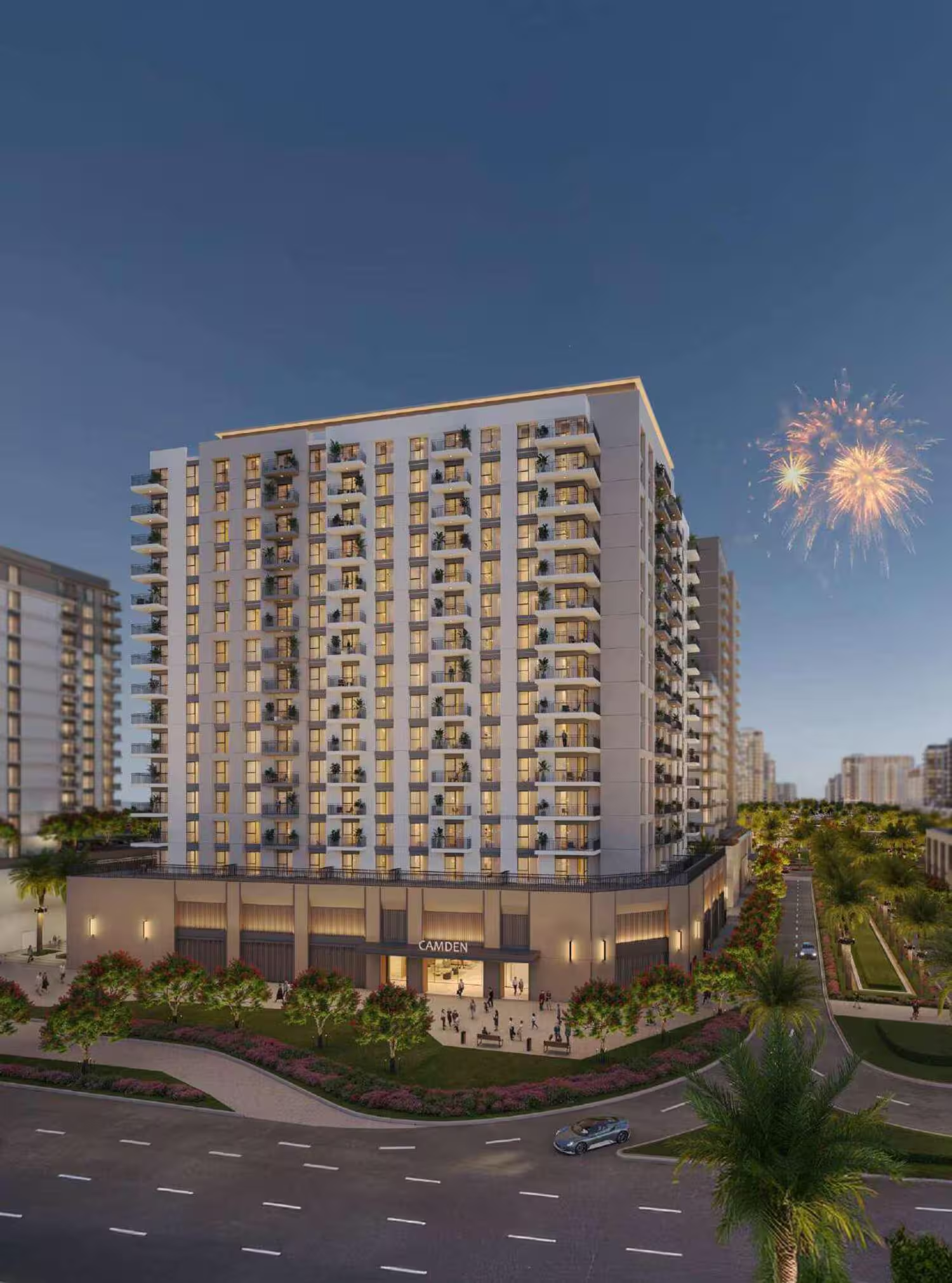
This matters because many plans leave a large amount for the keys. On our site, the median plan asks 40% at handover, and 387 of 991 projects ask 50% or more. For example, Camden in Town Square by Nshama, from AED 1,141,000 on our site in November 2026, has a 10 / 40 / 50 plan with handover listed for Mar 2028. If you plan to borrow that last 50%, ask a bank that lends to non-residents for an approval in principle before you book. If you cannot borrow, a post-handover payment plan can spread the payment instead. Read more in payment plans explained.
Taxes
The UAE has no annual property tax for owners and no personal income tax. Corporate tax does not apply to an individual's income from renting or selling property held in their own name, as long as the activity does not need a licence (Cabinet Decision No. 49 of 2023, WAM). Short-term holiday lets, which need a permit, can be different.
Your home country may still tax the rent, the gain when you sell, or the property when you die. Check with a tax adviser at home before you buy, not after.
Handover when you are not there
When the building is finished, the developer sends a completion notice. You pay the last instalment and any fees due at handover, then the home is inspected and the keys handed over. You can hire a snagging company to inspect for you. They send the list of defects to the developer to fix, and your POA holder, or the company if the developer allows it, can take the keys.
Dates can move. In the DLD project register as of 12 June 2026, 275 of 865 active projects (32%) had a registered completion date that had already passed. Read whether Dubai developers hand over on time before you plan a trip around a handover date.
If you will rent the home out, line up a property manager before handover. If you are buying partly for residency, the Golden Visa through property has its own rules.
Before you send money
- Check the developer and project on the DLD's website or the Dubai REST app.
- Check that the account in your SPA is the project's escrow account.
- Read the full SPA, or pay a UAE lawyer to read it.
- Make sure you can pay every instalment until handover without a loan.
- Decide who will act for you at handover, and start the POA early.
Sources
- Dubai Land Department, request to register the initial sale (Oqood), updated 3 November 2026: dubailand.gov.ae
- Dubai Land Department, Dubai REST app update: dubailand.gov.ae
- Regulation No. 3 of 2006, areas for ownership by non-UAE nationals, 7 June 2006: dlp.dubai.gov.ae
- UAE Ministry of Foreign Affairs, FAQs (attestation fees), checked 5 November 2026: mofa.gov.ae
- Central Bank of the UAE rulebook, amendments to Circular No. 31/2013 on mortgage loans: rulebook.centralbank.ae
- WAM, Ministry of Finance on Cabinet Decision No. 49 of 2023 (natural persons): wam.ae
- BSA via Legal 500, DLD Circular No. 29/R/2025 on powers of attorney, 19 August 2025: legal500.com
- HSF Kramer, Federal Decree-Law No. 10 of 2025 on AML, 2026: hsfkramer.com
- Afridi & Angell, Circular No. 5/2022 reporting requirements, 2022: afridi-angell.com
- The National, Central Bank confirms mortgage cap rules, 29 October 2013: thenationalnews.com
- Gulf News, history of the UAE dirham: gulfnews.com
- dubizzle, mortgages for non-resident investors: dubizzle.com
- Our analysis of the DLD project register as of 12 June 2026, and of the payment plans on the 991 projects on our site, November 2026